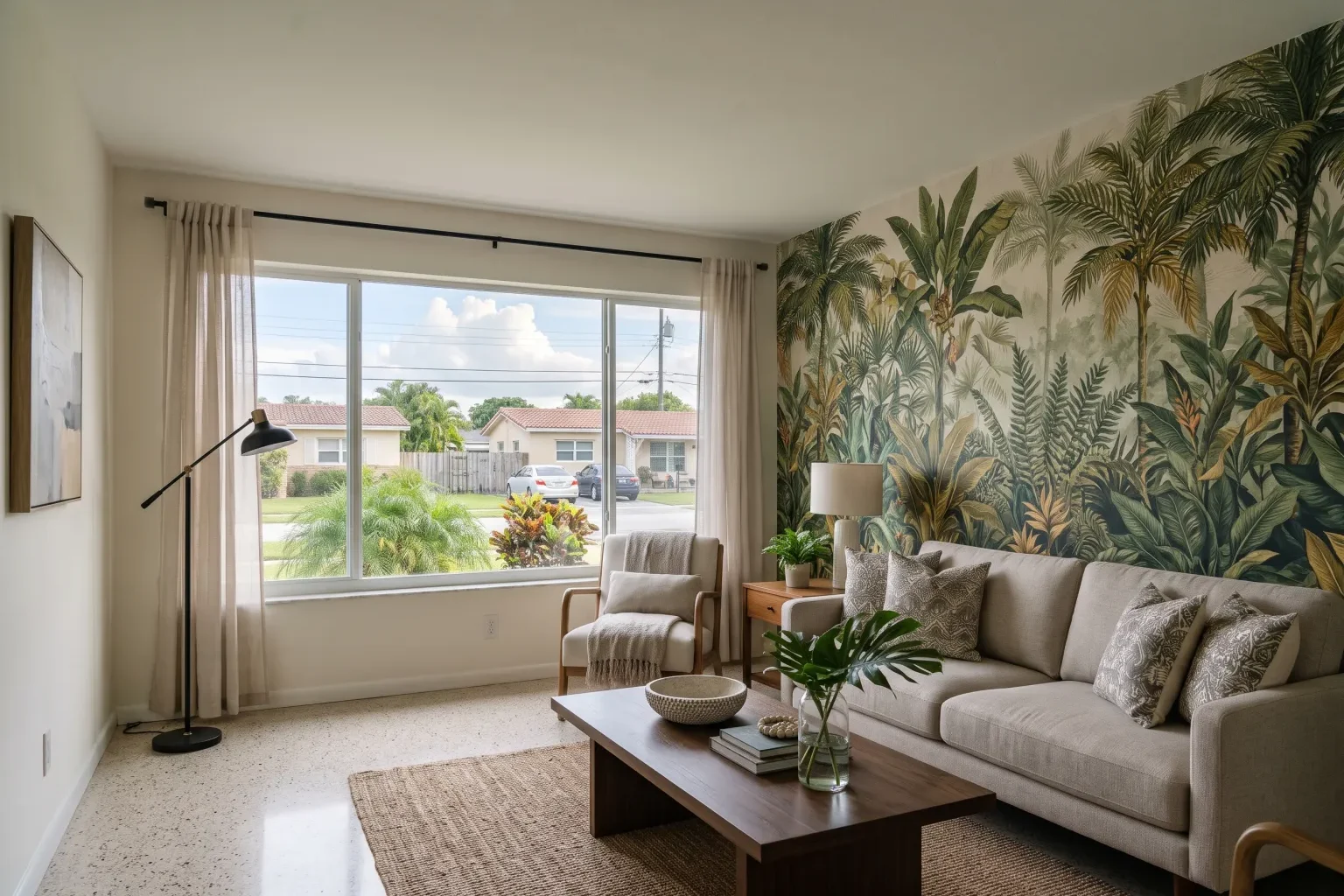
The short answer
Grasscloth does well in Miami Lakes homes when it is installed in a dry, air-conditioned room on a primed wall. We plan the panel sequence, keep paste off the face and suggest faux grasscloth for spaces that get wet.
Homeowners in Miami Lakes often ask us the same thing about grasscloth: will it survive South Florida? The honest answer is that it depends on the room, the prep and how the house is kept cool. Woven plant fiber reacts to water and humidity in ways paper and vinyl do not, so the right placement and handling matter a great deal. Our crew is based in Hialeah, only about 3 miles south of Miami Lakes, and we install both natural and faux grasscloth throughout ZIP code 33014. This page answers the climate question directly and lays out how we approach each project.
The climate question, answered
Miami Lakes shares the Miami-Dade weather pattern: hot, humid and stormy from May through October, then warmer and drier from November into April, with no fully dry season. Natural fiber absorbs moisture from the air and from any direct contact with water. When it gets wet, minerals and dyes can migrate, which shows up as tide lines or blotches.
In practice, that means two rules. First, keep genuine grasscloth in rooms that stay dry and conditioned year-round, such as bedrooms, living rooms, studies and dining rooms. Second, keep the home's air conditioning running steadily instead of shutting it off for long stretches. With those two habits, grasscloth can look good for many years here.
Real fiber or faux?
Both have a place, and many homes end up with each in different rooms. Real fiber delivers the depth and irregular texture that photographs well and feels warm in person. Faux options give a similar look with practical advantages in tougher rooms.
- Real grasscloth: richer texture, natural color variation, visible seams, needs dry rooms
- Faux grasscloth: consistent color, less visible seams, wipeable, handles bathrooms and kitchens
- Real fiber with a tight weave: a middle ground that resists snagging better
- Paper-backed versus non-woven backing: non-woven usually strips off more easily later
Before installation day
We measure the walls and recommend ordering every roll at once from a single production lot, plus a spare. Grasscloth lots can vary noticeably, and a reorder months later may not match. When the rolls arrive, keep them in a cool, dry room inside the house rather than the garage, so they adjust to indoor conditions.
The wall gets patched, sanded and primed with a pigmented primer tinted to the grasscloth's tone. That tinted base makes seam lines softer and keeps darker paint or patch marks from showing through the gaps in the weave.
Careful handling on the wall
Our installers keep the face of every panel clean. Paste is rolled onto the backing only, and we fold panels so the pasted sides meet without touching the fiber. After booking, each panel is positioned, brushed smooth with a soft brush and pressed into the corners.
We lay out all panels before hanging and check them side by side. Panels that are slightly darker or lighter go where they cause the least contrast, such as next to a window or in a corner. Trimming is done with fresh blades so fibers cut cleanly instead of pulling.
- Panels sequenced for even color flow
- Reversed or straight hang per the manufacturer
- Soft-brush smoothing, no plastic squeegee
- Immediate cleanup of any stray paste
Keeping grasscloth looking good for years
Once the panels are dry, care is mostly about avoiding water and abrasion. A soft brush attachment on the vacuum, run lightly from top to bottom every few months, keeps dust from settling into the weave. Skip feather dusters that can snag loose strands, and never spray glass cleaner or all-purpose sprays nearby, since overspray can spot the fiber.
Placement of furniture matters too. Chair backs, a headboard that rocks against the wall or a dog that leans on the same spot every day will slowly flatten or fray the texture. A few inches of space, or felt pads on the back of the furniture, prevent that. During hurricane season, from June through November, if the power goes out for an extended period and the house gets humid, open the room to circulate air once power returns and let the air conditioning bring humidity back down gradually.
Grasscloth service area
We install grasscloth in Miami Lakes, ZIP 33014, and nearby communities including Hialeah Gardens, Medley, Opa-locka, Miramar and Miami Gardens. Because the drive from Hialeah is short, it is easy for us to stop by, look at the room and discuss whether real or faux fiber is the right choice.
More services in Miami Lakes
- Wallpaper Installation in Miami Lakes
- Wallpaper Removal in Miami Lakes
- Accent Wall Installation in Miami Lakes
- Mural Installation in Miami Lakes