The short answer
Ceiling wallpaper works best in bedrooms, dining rooms, powder rooms and tray or coffered ceilings. Because strips hang upside down, we put extra effort into flattening and priming the ceiling, plan the layout from the room's main sightline, and use paper that suits overhead work.
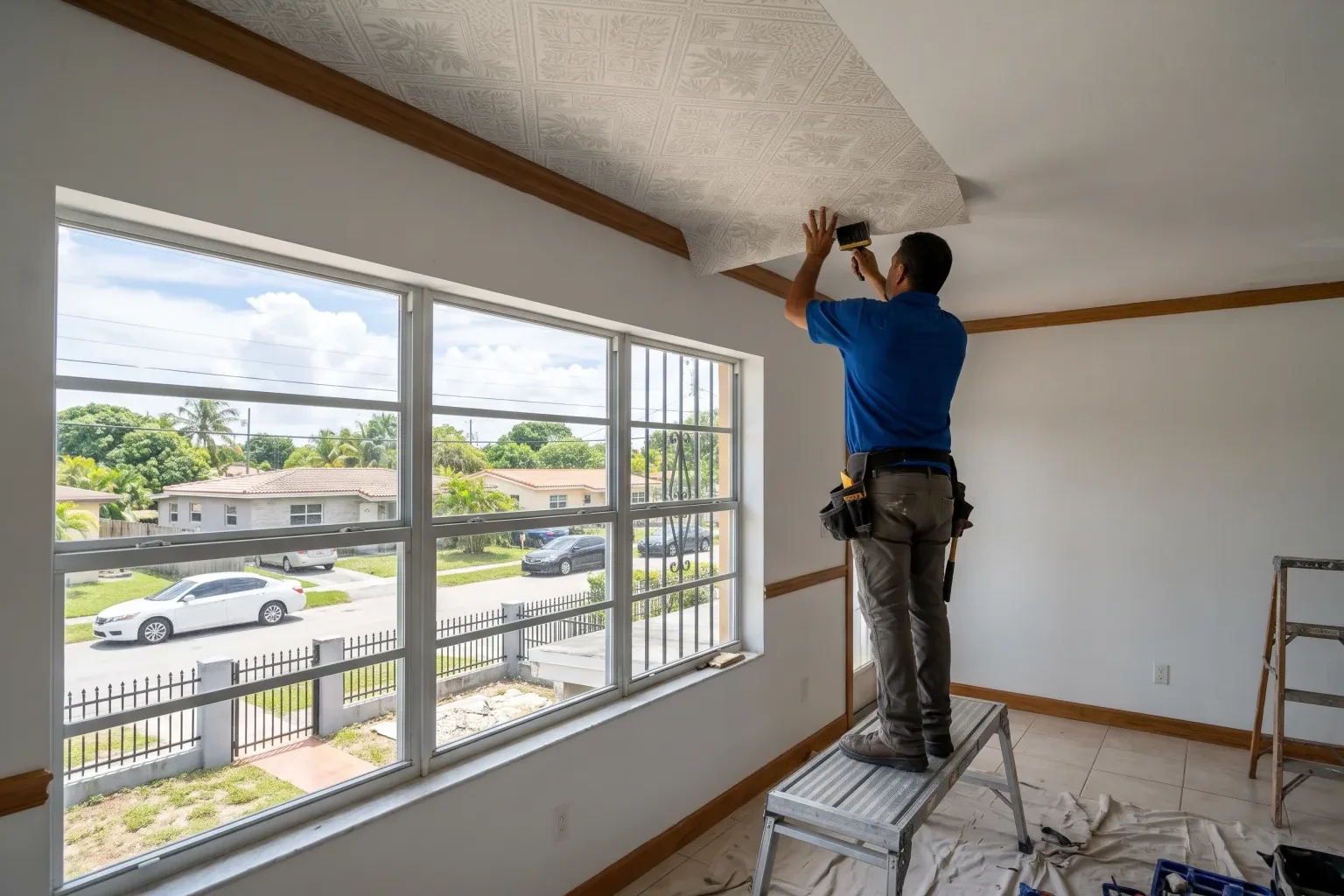
Most people never think of the ceiling as a surface for wallpaper, which is exactly why a papered ceiling gets noticed. A subtle texture can warm up a flat white bedroom ceiling, a metallic or botanical print can turn a powder room into a small surprise, and a tray or coffered section gives a pattern a ready-made frame. Overhead work is also the hardest kind of hanging: gravity pulls on every strip, the light from windows rakes across every seam, and the paper has to be held in place while it is smoothed. Dream Wallpaper Installers takes on ceiling projects across Hialeah and the surrounding area, and the notes below cover where a papered ceiling works, the extra prep it needs, how we hang it, what affects pricing, and how to care for it afterward.
Is your room a good fit for a papered ceiling?
The ceiling is often called the fifth wall, and in many Hialeah houses it is a wide, plain expanse of flat or popcorn finish. Covering it with paper makes sense when you want the room to feel more finished without filling the walls with pattern. Bedrooms are a favorite, since you see the ceiling from the bed. Dining rooms benefit too, especially around a chandelier. Small powder rooms are ideal for a bold print, because the area is small and the effect is big.
Tray ceilings, recessed panels and coffers are natural candidates because the architecture frames the paper and hides the outer edges. Flat ceilings in long rooms can work as well, but they ask for a careful layout so the pattern runs straight along the most visible line.
We are more cautious about bathrooms with weak exhaust fans, ceilings with active stains from roof or AC leaks, and very high ceilings in great rooms where staging takes more equipment. Those jobs are still possible, but we will be honest about the moisture risk and the added setup.
- Primary bedrooms and guest rooms
- Dining rooms with a central light fixture
- Powder rooms and small half baths with good ventilation
- Tray ceilings, recessed panels and coffers
- Covered lanai or porch ceilings only with materials rated for that use
Preparing a ceiling to hold paper overhead
A ceiling has to be flatter and better bonded than a wall, because any weak spot in the old finish will let go under the weight of wet paper. Popcorn and heavy knockdown textures need to be removed or skimmed smooth first. We check for loose tape joints on drywall ceilings, cracks along the block walls where many South Florida ceilings meet the top of the masonry, and any brown rings that suggest a past leak.
Water stains get sealed with a stain-blocking primer so they do not bleed through light paper. Cracks are taped and patched, and the whole surface is sanded and cleaned of dust. Light fixtures and smoke detectors are taken down or loosened so the paper can be cut neatly behind the canopy, with power turned off where needed.
The final coat is a wallpaper primer with strong initial tack. On a ceiling, that grip matters: it helps each strip stay where we set it instead of sagging before the paste takes hold.
Our ceiling installation sequence
Overhead hanging goes slower than wall work, and we plan the job around that. We bring stable ladders or a plank setup so the installer can walk the length of a strip, and on wide ceilings two people often work together, one supporting the folded strip while the other smooths.
Most ceilings are papered across the shorter dimension so strips are easier to manage. We still decide the direction based on where the room is entered and where light comes from, because seams that run toward a window are less visible than seams running across the light.
- Measure the ceiling, locate the main sightline from the doorway or bed, and choose strip direction.
- Snap a straight reference line off the longest true edge, since ceilings and walls are rarely square.
- Cut strips with allowance for trimming at both walls, accounting for the pattern repeat.
- Paste and fold each strip accordion style so it can be lifted and unfolded a section at a time.
- Set the strip against the line, smooth from the center outward, and match the pattern to the previous strip.
- Roll seams gently and clean away paste before it dries.
- Trim at the wall line or crown molding, and cut neatly around fixtures, vents and detectors.
- Reinstall fixtures and covers once the paper has started to set.
Factors that shape the price of a ceiling job
Ceiling work is priced after we see the room, since the same square footage can mean very different effort. Here is what we look at:
We list these openly on your quote so you can see where the time goes and decide whether a different paper or a smaller area, such as just the tray, would be a better fit.
- Existing finish: removing popcorn or skimming texture adds a full prep stage.
- Ceiling height: standard rooms need ladders, while vaulted or double-height spaces need scaffolding.
- Paper weight and type: lightweight, nonwoven papers are easier overhead than heavy vinyls or natural fibers.
- Pattern repeat and match: large drop matches use more paper and slow down every strip.
- Shape and fixtures: trays, coffers, beams, fans and recessed lights all add cutting and fitting time.
- Room size: more strips simply mean more time on the ladder.
Living with a papered ceiling in South Florida
Ceilings collect less dirt than walls, so care is mostly about moisture and air movement. Keep the AC running steadily, especially from May through October when afternoon storms push humidity up, and use the exhaust fan in any bathroom with a papered ceiling during and after showers.
Dust once in a while with a soft, long-handled duster. If a ceiling fan is mounted in the middle of the paper, clean the blades regularly so they do not throw dust onto the surface. Watch for any new stain after a heavy storm during hurricane season; a roof or AC drain leak shows up on the ceiling first, and catching it early protects both the paper and the drywall above it.
Store leftover paper indoors in a cool closet so it is available for a patch if a fixture ever has to be moved.