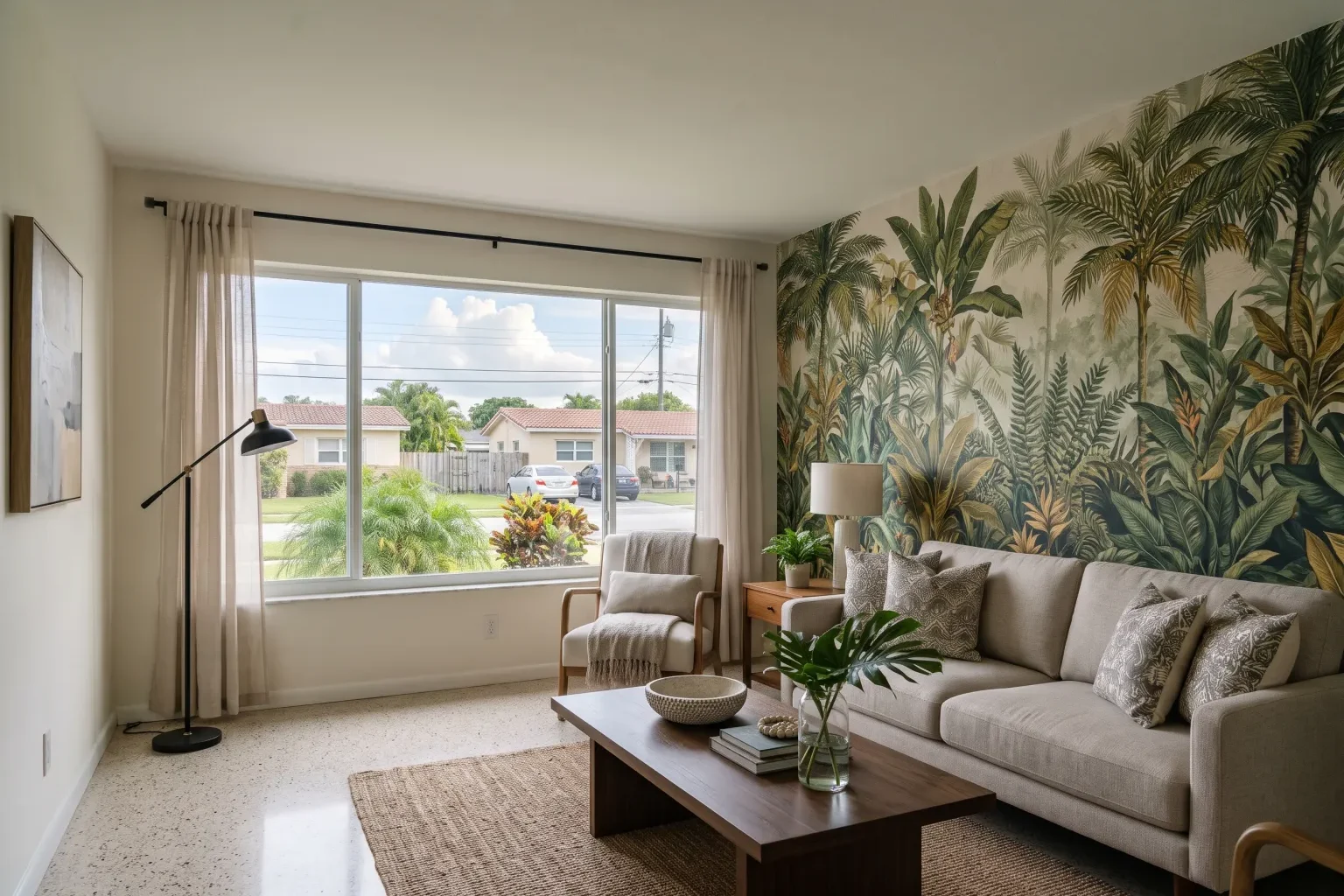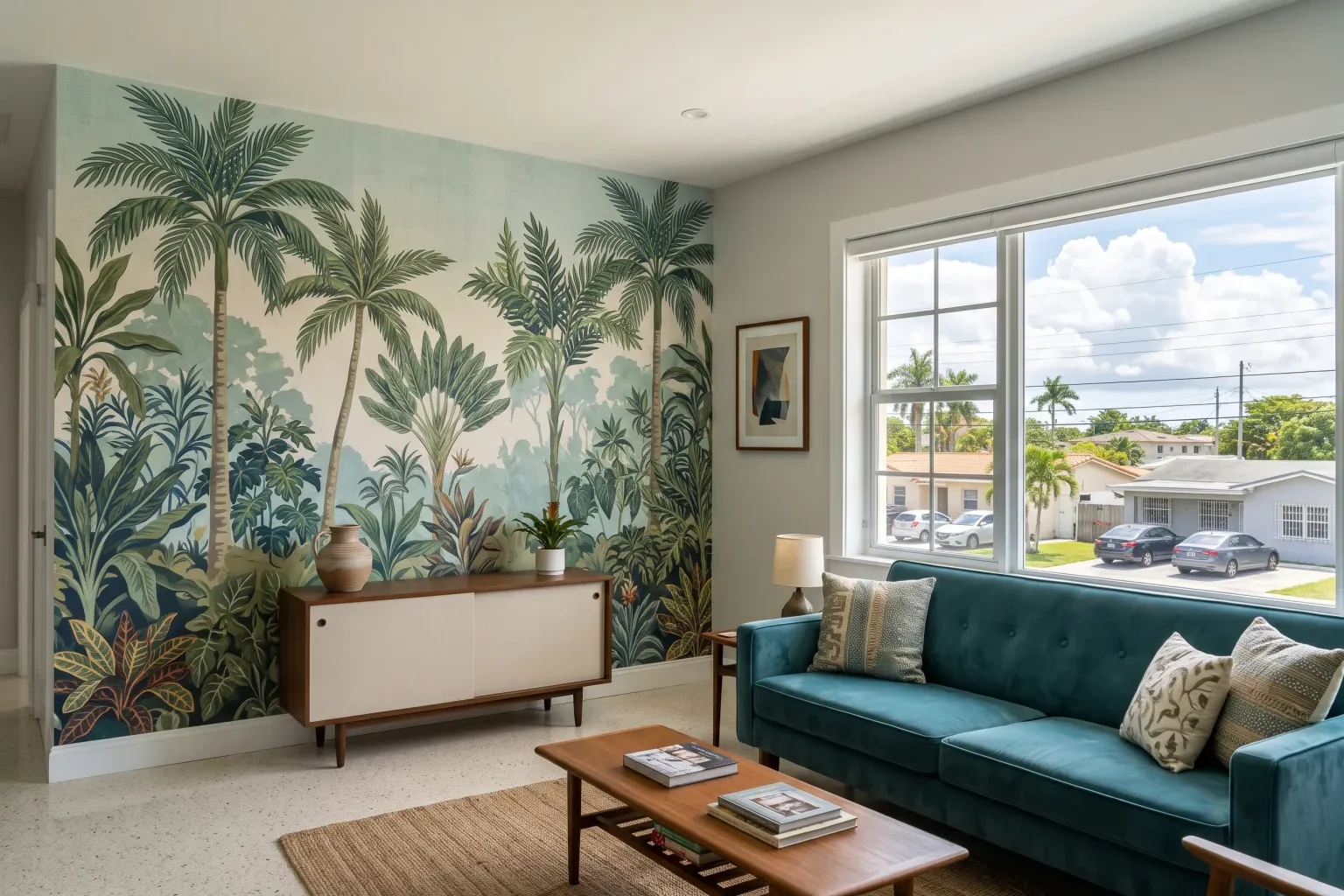
The short answer
A mural works best on one uninterrupted wall that becomes the focal point of a room. We repair and prime the surface, dry-lay every numbered panel, start from a plumb line, match the image across each seam, and trim to the ceiling and floor.
A mural is one continuous image split into numbered panels: a palm canopy, a misty forest, a city skyline, a map, an abstract wash of color. Unlike repeating wallpaper, there is exactly one correct place for every panel, and a mistake of a quarter inch at the first drop can leave a horizon line crooked across the entire wall. Dream Wallpaper Installers puts up printed murals in Hialeah, Miami Lakes, Miami Springs and nearby parts of Miami-Dade County. Below you will find how we judge a wall for a mural, the prep work behind a clean result, the order we hang panels in, what changes the scope of a project, and how to keep the image crisp for years.
Picking the right wall for a mural
The strongest mural walls are wide, flat and free of clutter. A bedroom wall behind the bed, a living room wall facing the entry, a child's room, a home gym or a dining nook usually fits the bill. Windows, doors and thermostats cut into the image, so a wall with few interruptions keeps the picture readable. When a homeowner asks us about a wall full of openings, we usually suggest a geometric or textured mural design over a scene with a clear subject, because nobody notices a missing chunk of abstract pattern.
Scale matters as much as the wall. Print shops size murals to your measurements, so we recommend having us measure before you order. That way the important part of the image, such as a tree trunk or a focal building, lands where your eye goes first and not behind a headboard or a television.
Surface work before the first panel
Murals are typically printed on smooth paper, vinyl or non-woven substrates, and smooth stock shows every bump underneath. Our prep starts with a raking light held close to the wall to find dents, old anchor holes, drywall tape lines and the orange-peel texture common in Florida tract homes. Heavy texture often needs a skim coat so the image does not look dimpled.
After repairs cure and are sanded, we roll on a wallcovering primer. The primer seals fresh joint compound, gives the paste a uniform surface and makes the mural strippable later without tearing the drywall face. For walls that back onto a bathroom or an exterior block wall, we take a moisture reading. In the humid season, condensation inside a wall chilled by the air conditioning can work its way behind the panels, and we prefer to find that before installation rather than after.
- Raking-light inspection for flaws
- Patch, sand and skim coat textured areas
- Seal with a wallcovering primer
- Check moisture on exterior and wet-room walls
Our panel-by-panel sequence
First, we unroll every panel on a clean floor in numbered order and confirm the full image is there, with no misprints, color shifts or creases from shipping. This dry lay is where we catch a missing panel, not halfway up a ladder.
Second, we decide where the image should sit. Most murals include bleed, extra image at the edges meant to be trimmed off. We center the composition or shift it slightly so the key element hits the visual center of the wall, then mark a plumb line where panel one begins. Older homes rarely have perfectly square corners, so the plumb line, not the corner, governs the layout.
Third, panels go up one at a time. Depending on the product, we paste the wall, paste the panel, or peel a liner. Each new panel is matched to its neighbor at several points along the seam, top, middle and bottom, so lines and shapes continue without a jog. Some murals are designed with a small overlap that we double-cut through both layers for a seamless butt joint; others are printed edge to edge for a straight butt.
Fourth, we smooth from the center outward to push air to the edges, roll seams lightly, and wipe paste from the surface right away. Finally, we trim the excess at the ceiling line, baseboards, window casings and outlet openings with a straightedge and a sharp blade, then replace cover plates.
What shapes the price of a mural project
No two mural jobs are quoted the same way, because no two walls are alike. A wall needing a skim coat or stripping of an older covering adds prep hours. The mural material itself changes handling: heavy commercial vinyl is stiff and needs more muscle on tall drops, while thin paper tears easily when wet and must be handled slowly.
The image affects labor too. Detailed scenes with fine lines across seams take longer to align than soft, blurry gradients. Taller ceilings call for scaffolding and an extra installer, and a very wide wall simply means more panels. A wall interrupted by windows or a fireplace adds careful cutting. After we measure, you get a clear written scope.
Keeping the image sharp
Care depends on the mural's surface. Vinyl and coated non-woven murals can usually be wiped with a damp microfiber cloth and mild soap. Uncoated paper murals should only be dusted. Test any cleaning method in a corner that furniture hides.
Ink fades under direct sun, so a mural facing west-facing glass benefits from blinds or UV film. Steady indoor humidity protects the paste bond, which means keeping the air conditioning on when the house is closed. If a hurricane outage leaves the home warm and damp for several days, open the house up and dry it out as soon as power returns, then check the seams. A lifted edge caught early is a quick fix.
Mural Installation by city
- Mural Installation in Miami Lakes
- Mural Installation in Medley
- Mural Installation in Hialeah Gardens
- Mural Installation in Miami Springs
- Mural Installation in Opa-locka
- Mural Installation in Doral
- Mural Installation in Miami Gardens
- Mural Installation in Miramar
- Mural Installation in Sweetwater
- Mural Installation in West Miami
- Mural Installation in North Miami
- Mural Installation in Miami